
Flood Management with floodOPT
 For mature fields, significant optimization potential exists simply realigning patterns by modifying well rates to promote sweep and reduce fluid cycling. Unfortunately, engineers typically only know which producers are high watercut or high water rate wells, but not which injectors are responsible for these effects making pattern realignment difficult. Using Streamsim's streamline-based analysis, injector-producer pairs are easily identified and well-pair connections can be quantified at any given time. floodOPT then uses the well-pair information to identify opportunities to reduce fluid cycling and increase sweep efficiency. The goal of floodOPT is to provide new well rate targets for both injectors and producers that prompt the efficient connections and demote the inefficient connections. In this manner, floodOPT provides a systematic reservoir engineering approach, based on historical injection/production data, dynamic patterns and allocation factors, to give next month's well rate targets.
For the 16th Matzen field peripheral waterflood in Austria, surveillance along with our floodOPT workflow resulting in an oil production increase of 3% (35,000 stb) in one year, the Belridge field in California showed a reversal in oil decline, the Wilmington field in California reduce oil decline from 20% to 2% over one year, in the 8th Tortonian in Austria incremental oil production was 35,000 STB in 30 months, and in Argentina the oil decline for a water flood was reduced from 16% to 0% for the following 3 months.
|
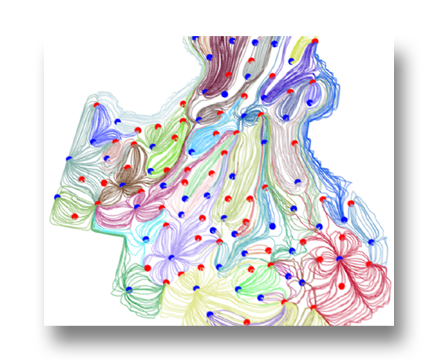
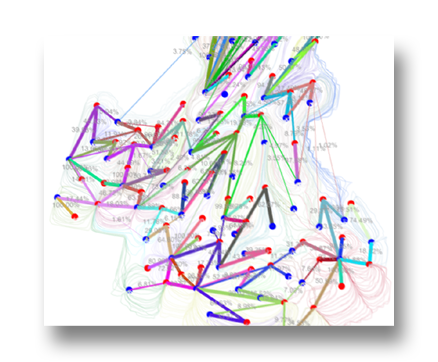
More Info: Pricing, SPE Paper, SPE Paper Presentation Support: Knowledge Base, Tutorials, Training The floodOPT WorkflowOne powerful aspect of streamline simulation is the ability to create a snapshot of which injectors support which producers, and how much fluid is allocated between injector/producer pairs. Thus it is possible to related injected water volumes to off-set oil production down to a well-pair level and be displayed using Streamsim's patented Flux Pattern map (FPmap).
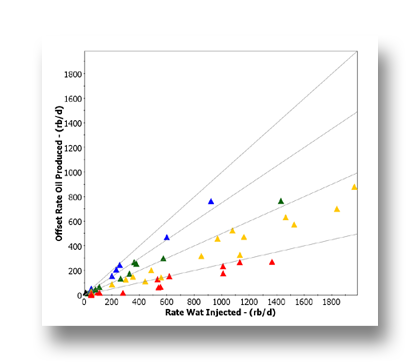
Since offset oil production is related to water injection this information can also be displayed in a cross-plot for every injector in the field at any given point in time. This novel information leads to the idea of injection efficiencies--a ratio of off-set oil production to water injected--which in turn can be used to manage the flood. The injection efficiency is defined as the ratio of off-set oil production to water injected. Note the following about the injection efficiency:
For details see on floodOPT, the weight funciton, and workflow see Thiele, M.R. and Batycky, R.P.; "Using Streamline-Derived Injection Efficiencies for Improved Waterflood Management," SPEREE April 2006, Vol 9, No 2, pp187-196. FeaturesfloodOPT is based on either a surveillance or simulation model and allows to:
|
|
| floodOPT Example Workflow within studioSL | |
|
studioSL offers a convenient way to apply floodOPT to a 3DSL run for flood management purposes and forecasting. The starting point is a 3DSL simulation omodel with an acceptable well-level history match (see more about history matching here) or a surveillance model. In case of a simulation model, the well-level history match is an important component of any reliable forecast since floodOPT uses well-pair injection/production information. The basic steps in a floodOPT workflow are:
Download our surveillance dataset here. Follow our surveillance tutorial here, to create the FPmap from the production data. Follow our floodopt tutorial here, to create a floodOPT project. |

 Once the injection efficiency is known for each well-pair, new well rates can be computed to promote good connections and demote poor connections. A plot/listing of suggested new well rates is then is calculated (delta changes shown in figure at right). Because the definition of good vs. poor is arbitray, the user can override the default setting of the reference point using an economic watercut or a user-specific watercut value.
 Contact in USA
Corporate Headquarters 
StreamSim Technologies, Inc.
865 25th Avenue
San Francisco, CA 94121
U.S.A.
Tel: (415) 386-0165
Contact in Canada
Canada Office 
StreamSim Technologies, Inc.
Suite 102A - 625 14th Street N.W.
Calgary, Alberta T2N 2A1
Canada
Tel: (403) 270-3945