

Sweep Management with floodOPT

In mature conventional floods, significant optimization can be achieved by adjusting well rates to realign patterns, enhancing sweep efficiency, and reducing fluid cycling. Streamlines facilitate this process by identifying injector-producer pairs and quantifying their connections over time. Using this information, floodOPT generates well rate targets for both injectors and producers.
floodOPT is used in fields world-wide with 10's to 1000's of wells, and each time demonstrating incremental gains to oil production and/or reduced fluid cycling. A list of publish case studies is at the bottom of this page.
floodOPT Workflow
Simulation/Surveillance Model Through End of History
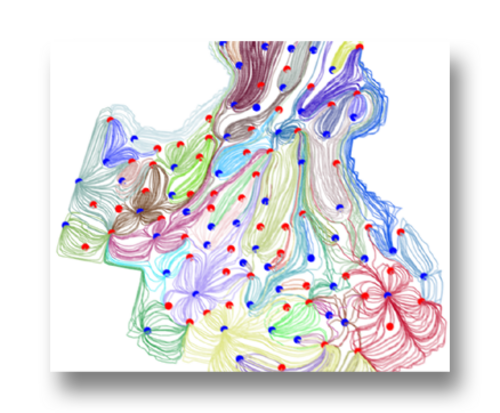
The starting point for optimizing an existing flood begins with a 3DSL simulation or surveillance model that has been run through to the end of the historical data.
The most recent timestep(s) streamline paths are used to quantify the well-pairs, injector patterns, and well rate allocation factors (FPmap).
Select Wells (Patterns) and Set Constraints
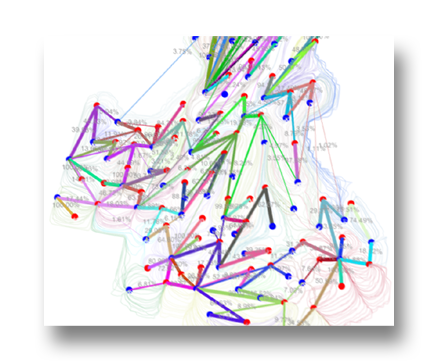
Generate Target Rates
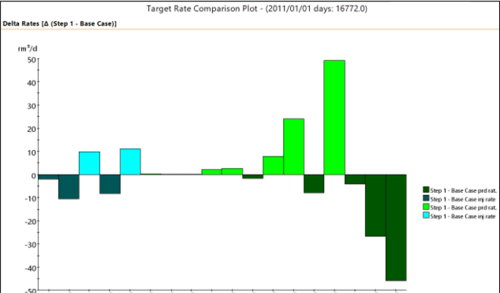
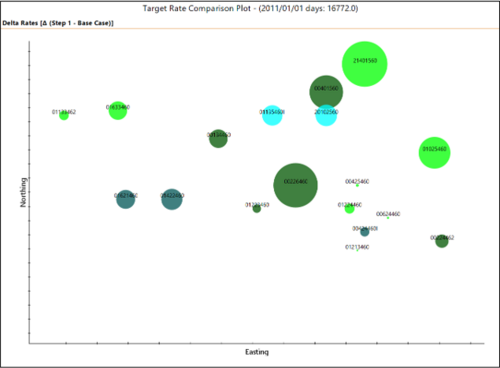
Run FloodOPT to generate target rates that enhance sweep efficiency and minimize cycling while adhering to the selections and constraints defined in step 2.
Forecast
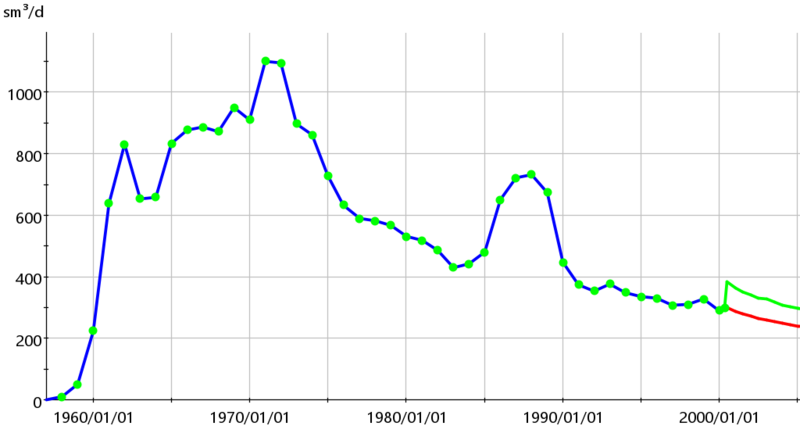
Both simulation and surveillance models can be used to predict the response to the new target rates generated by FloodOPT in step 3.
The forecast duration is user-defined. FloodOPT can also be run at a preset frequency (e.g., every n months) to track how rate targets evolve in response to changes in flood efficiency over time.
Case Studies
Published case studies using our technology for flood optimization.
- SPE 214828 – GSLAU/Kinder Morgan oil decline reduced from 22%/year to 10%/year
- SPE 209679 – Matzen Field/OMV 3% increase in field-wide oil production over 1 year
- SPE 209281 – Belridge/Aera Energy reversal in oil decline
- SPE 195372 – Wilmington/CRC oil decline reduced from 20% to 2% over 1 year
- SPE 166393 - Matzen Field/OMV 35000 STB incremental oil over 2 years
Features
floodOPT is based on either a surveillance or simulation model and allows to:
- Generate rate targets for any number of injectors and producers
- Apply field injection rate constraints as well rate constraints to the final target rates.
- Define what a good vs. poor connection is based on field average water cut, group water cut, or economic limit water cut.
- Automatically pass rate targets back to 3DSL (or Eclipse, IX) for forecasting in a simulation model.
- Export rate targets to Excel.
- When using multiple geological models (see Uncertainty Quantification) display the range in well target rates across all models.
- Download our surveillance dataset here.
- Follow our surveillance tutorial here, to create the FPmap from the production data.
- Follow our floodopt tutorial here, to create a floodOPT project.
- Refer to the original source on FloodOPT for more details: Thiele, M.R. and Batycky, R.P.; "Using Streamline-Derived Injection Efficiencies for Improved Waterflood Management" SPEREE April 2006, Vol 9, No 2, pp187-196.